




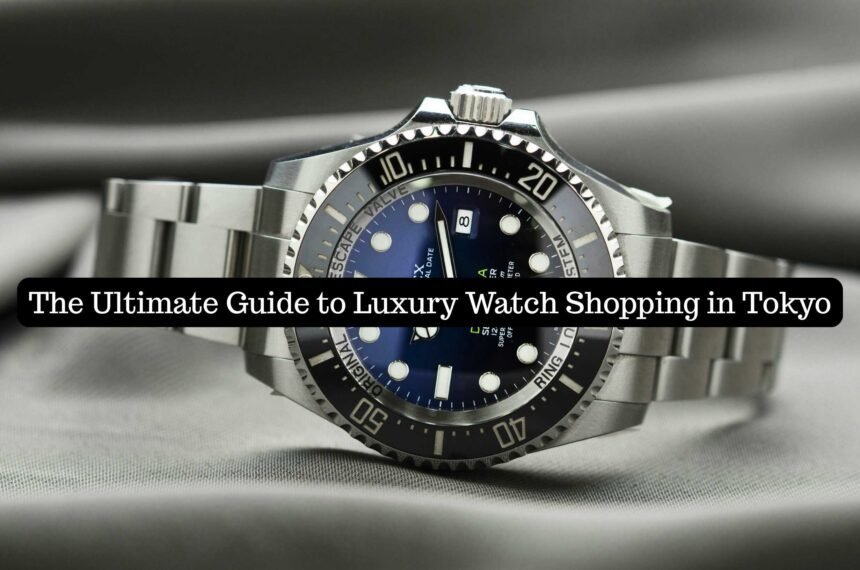
Few cities in the world can rival Tokyo when it comes to the depth, precision, and sheer sophistication of its horological marketplace.
- Why Tokyo Stands Apart in Luxury Watch Shopping
- Ginza: The Epicenter of Flagship Luxury
- Shinjuku and Shibuya: Depth and Diversity
- Nakano Broadway: Tokyo’s Hidden Vintage Treasure
- The Investment Dimension of Tokyo’s Watch Market
- Japanese Watchmaking: Grand Seiko and Beyond
- Navigating Tax-Free Purchasing and Export
- The Role of Auction Houses and Private Sales
- Key Considerations for the International Buyer
- A Forward-Looking Perspective on Luxury Watch Shopping in Tokyo
From gleaming flagship maisons along Ginza’s Chuo-dori to the quietly extraordinary vintage dealers tucked into the upper floors of Nakano Broadway, the Japanese capital offers a watch-buying ecosystem that is, in many respects, without parallel.
For the discerning collector, the seasoned investor, or the international buyer seeking a singular acquisition experience, luxury watch shopping in Tokyo represents not merely a transaction but an immersion into a culture where craftsmanship, provenance, and meticulous care converge.
Tokyo’s position within the global luxury watch market has strengthened considerably over the past two decades. The city benefits from Japan’s deeply ingrained appreciation for mechanical precision, an obsessive standard of product condition that surpasses most Western markets, and a retail infrastructure that caters simultaneously to first-time buyers and elite collectors pursuing six- and seven-figure references.
Whether one seeks a current-production Patek Philippe Nautilus, a discontinued Rolex Daytona variant, or a pristine Grand Seiko from the 1960s, Tokyo’s marketplace delivers with a level of curation rarely found elsewhere.
This guide offers an authoritative examination of Tokyo’s luxury watch landscape – its key districts, the cultural forces that shape its market, the investment considerations that matter, and the refined experiences that await those who approach the city with knowledge and intent.
Why Tokyo Stands Apart in Luxury Watch Shopping
The distinction of Tokyo’s horological market rests on several foundational pillars.
First is the Japanese concept of monozukuri – the art of making things with exceptional care and attention. This philosophy extends beyond domestic watchmaking into how pre-owned timepieces are handled, stored, and presented for resale.
A watch that has circulated through the Japanese secondary market often arrives in demonstrably superior condition compared to equivalent pieces from European or American dealers, a reality that international buyers have come to rely upon.
Second is the scale and segmentation of Tokyo’s retail environment. No other city offers such a dense concentration of authorized boutiques, independent dealers, auction specialists, and vintage curators within a relatively compact urban footprint.
This density creates a competitive ecosystem that benefits the buyer – prices are sharp, authentication standards are rigorous, and the selection at any given moment is remarkably deep.
Third, and perhaps most significant for international visitors, is the favorable tax structure. Japan’s tax-free shopping provisions for foreign passport holders, combined with periodic currency advantages when the yen softens against the dollar, euro, or pound, can result in meaningful savings on high-value acquisitions – savings that compound when purchasing multiple pieces or references at the upper end of the market.
Ginza: The Epicenter of Flagship Luxury
Any serious discussion of luxury watch shopping in Tokyo begins in Ginza. This storied district has served as the nation’s premier retail corridor for over a century, and its concentration of horological flagships is unmatched. Along Chuo-dori and the surrounding blocks, one finds the dedicated boutiques of Rolex, Patek Philippe, Audemars Piguet, Vacheron Constantin, A. Lange & Söhne, and Breguet, among others. The Wako building at the Ginza 4-chome crossing — crowned by its iconic clock tower – remains a symbol of Japanese horological culture and houses an exquisite selection of premium timepieces.
The Authorized Boutique Experience
Ginza’s authorized boutiques offer more than product access. They provide a purchasing experience calibrated to the expectations of high-net-worth individuals: private viewing rooms, multilingual staff trained in technical horology, and, in select cases, access to limited allocations that may not be available through standard retail channels. For collectors pursuing allocation-dependent references from brands such as Rolex or Patek Philippe, cultivating a relationship with a Ginza boutique can prove strategically valuable over time.
Shinjuku and Shibuya: Depth and Diversity
Beyond Ginza, Tokyo’s watch market extends into Shinjuku and Shibuya, where major multi-brand retailers and pre-owned specialists operate at scale. Establishments in these districts frequently carry inventories numbering in the thousands of pieces, spanning current production, recently discontinued references, and sought-after vintage models. The experience here is less about the hushed exclusivity of a flagship boutique and more about the thrill of discovery – the possibility of encountering a rare dial variant, an overlooked complication, or a full-set example of a reference that has appreciated significantly on the secondary market.
Several of Tokyo’s most respected pre-owned dealers maintain their primary showrooms in these districts, offering authentication guarantees, comprehensive service histories, and the kind of transparent grading systems that inspire confidence in both domestic and international buyers.
Nakano Broadway: Tokyo’s Hidden Vintage Treasure
For the collector who values provenance and patina, Nakano Broadway occupies a singular position in Tokyo’s horological geography. This unassuming shopping complex in the city’s western reaches houses a remarkable concentration of specialist vintage watch dealers, many of whom have spent decades cultivating expertise in specific brands or eras. It is here that one might find an original-condition Universal Genève Compax, a tropical-dial Tudor Submariner, or a Grand Seiko 44GS in exhibition-grade condition.
Nakano rewards patience and knowledge. Prices can be extraordinarily competitive for buyers who understand what they are examining, and the dealers themselves – though sometimes modest in their presentation – possess deep technical knowledge and a genuine passion for horology that transcends commerce.
The Investment Dimension of Tokyo’s Watch Market
The intersection of luxury watches and investment has matured significantly, and Tokyo sits at the center of this evolution in the Asia-Pacific region. Several factors make the city’s market particularly relevant for those approaching horology with a long-term value perspective:
- Condition premium: Japanese-market watches consistently command higher resale values internationally due to their superior preservation standards, making Tokyo an ideal sourcing destination for investment-grade pieces.
- Access to discontinued references: Tokyo’s deep secondary market provides access to discontinued models that have demonstrated sustained price appreciation, including specific Rolex sports references, Patek Philippe complicated watches, and select independent brand pieces.
- Currency dynamics: Strategic timing of purchases during favorable yen exchange periods can enhance effective returns, a consideration that sophisticated international buyers increasingly factor into their acquisition planning.
- Provenance value: A Japanese-market provenance – complete with original papers, boxes, and service records maintained to exacting standards – adds a quantifiable premium when pieces eventually re-enter the global market.
It bears noting that investment in luxury timepieces, while potentially rewarding, requires the same disciplined analysis one would apply to any alternative asset class. Rarity, brand heritage, mechanical significance, and condition remain the primary drivers of long-term value appreciation.
Japanese Watchmaking: Grand Seiko and Beyond
No guide to Tokyo’s watch market would be complete without acknowledging the remarkable ascent of Japanese haute horlogerie, led by Grand Seiko. The brand’s Spring Drive movement – a proprietary technology that bridges mechanical and electronic watchmaking – represents one of the most significant caliber innovations of the past half-century. Grand Seiko’s finishing, executed at the Shinshu and Shizukuishi ateliers, rivals and in certain respects surpasses that of established Swiss manufactures at equivalent price points.
Visiting the Grand Seiko boutique in Ginza offers international buyers the opportunity to examine Japan-exclusive references and limited editions that are not available in overseas markets. These pieces, produced in small quantities and often featuring dials inspired by Japanese natural phenomena, have become increasingly coveted by global collectors and represent compelling value propositions relative to their Swiss counterparts.
The Broader Japanese Independent Scene
Beyond Grand Seiko, Tokyo provides access to independent Japanese watchmakers such as Hajime Asaoka and Masahiro Kikuno, artisans producing handcrafted timepieces in extremely limited numbers. These are watches that exist at the intersection of art and engineering, and acquiring them requires engagement with Tokyo’s specialist dealer networks – a pursuit that rewards those willing to invest time and cultivate relationships within the city’s horological community.
Navigating Tax-Free Purchasing and Export
International buyers benefit from Japan’s consumption tax exemption on purchases exceeding ¥5,000 when made by non-resident visitors. For a luxury watch acquisition, this translates to a meaningful reduction – currently ten percent – applied at the point of sale. Most authorized boutiques and established pre-owned dealers in Tokyo are equipped to process tax-free transactions efficiently, requiring only a valid passport and adherence to straightforward documentation procedures.
For buyers acquiring multiple high-value pieces or making purchases that will be shipped internationally, consulting with the retailer regarding customs declarations and import duties in one’s home country is advisable. Reputable Tokyo dealers are accustomed to facilitating cross-border transactions and can provide the documentation necessary to ensure a seamless process.
The Role of Auction Houses and Private Sales
Tokyo’s auction market, anchored by the presence of Christie’s, Sotheby’s, Phillips, and domestic houses such as Shinwa Auction, adds another dimension to the city’s horological ecosystem. Seasonal watch auctions in Tokyo regularly feature exceptional lots – from important vintage Patek Philippe references to rare Japanese-market Rolex examples – and provide a transparent, competitive environment for acquiring pieces that seldom appear in retail settings.
For collectors operating at the highest levels, private sales facilitated through established Tokyo dealers offer discretion and access to pieces that never reach the public market. These transactions, built on trust and long-standing relationships, represent the most exclusive tier of luxury watch acquisition in the city.
Key Considerations for the International Buyer
Approaching Tokyo’s watch market with preparation yields the strongest outcomes. Several factors merit consideration:
- Research specific references in advance: Tokyo’s market moves quickly, and knowing precisely what one seeks allows for decisive action when the right piece emerges.
- Verify authentication credentials: Reputable dealers provide detailed condition reports, movement photographs, and authentication guarantees. Insist on comprehensive documentation.
- Understand the grading vocabulary: Japanese dealers use specific condition-grading terminology. Familiarizing oneself with these standards prevents misunderstanding and ensures alignment of expectations.
- Engage with specialists: The most rewarding acquisitions in Tokyo often result from relationships with knowledgeable advisors who understand both the local market and the buyer’s collecting objectives.
A Forward-Looking Perspective on Luxury Watch Shopping in Tokyo
As the global luxury watch market continues to evolve; shaped by shifting consumer demographics, the maturation of the secondary market, and the growing significance of Asian collectors – Tokyo’s position as a preeminent destination for horological acquisition appears not only secure but ascendant.
The city’s unique combination of authorized retail excellence, unparalleled pre-owned inventory, favorable purchasing conditions for international visitors, and a cultural ethos rooted in precision and care creates an environment that serves collectors and investors with equal distinction.
Luxury watch shopping in Tokyo is, ultimately, an experience that reflects the city itself: meticulous, layered, and endlessly rewarding for those who approach it with the seriousness and curiosity it deserves.
Whether one departs with a contemporary masterpiece from a Ginza flagship or a quietly extraordinary vintage reference discovered in Nakano, the acquisition carries with it something beyond the mechanical; a connection to a city and a culture that understands, perhaps better than anywhere else, the enduring value of getting the details right.