



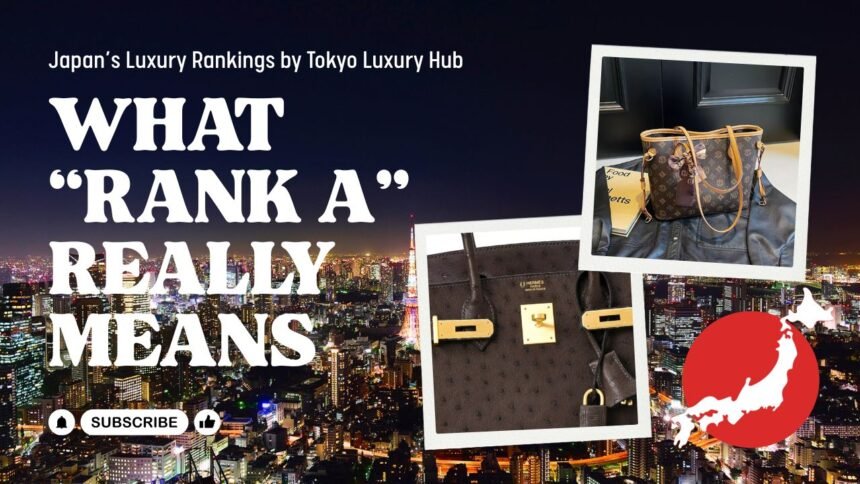
If you’ve ever browsed a Japanese luxury resale site or visited a boutique in Shinjuku, you’ve likely noticed a series of letters attached to every price tag: N, S, A, AB, B.
To the uninitiated, these are just letters. To a seasoned collector, this alphabet is the secret to finding a $10,000 Chanel bag for $6,500 that looks like it just left the boutique yesterday.
Japan’s luxury grading system is famously strict—arguably the most rigorous in the world. In this guide, we’re going to decode the most coveted tier of all: Rank A.
The Cultural “Why”: Why Japan Grades Harder
In many Western markets, a bag is either “New” or “Used.”
In Japan, the culture of Mottainai (regret over waste) and a deep-seated respect for craftsmanship means that luxury items are treated with extreme care.
When a Japanese inspector looks at a bag, they aren’t just looking for holes or stains; they are looking for “micro-flaws” that most Western buyers wouldn’t even notice.
This is why a Rank A item from Tokyo often outperforms an “Excellent Condition” item from a US-based reseller.
The Rankings Decoded: Where Does Rank A Sit?
To understand Rank A, you first need to see the hierarchy:
| Rank | Status | What it Actually Means |
| Rank N | New | Brand new, never sold to a consumer, often with protective seals. |
| Rank S / SA | Mint | Pre-owned but virtually indistinguishable from new. No visible wear. |
| Rank A | Excellent | Lightly used. Beautiful condition with only microscopic signs of wear. |
| Rank AB | Very Good | Visible but minor signs of use (slight corner rubbing or faint scratches). |
| Rank B | Good | Clear signs of use. Great for “daily drivers” where you don’t mind a patina. |
What Exactly is “Rank A”?
When an item is designated as Rank A, it is the “Sweet Spot” for luxury buyers. It offers the best balance between a significant discount and a “like-new” aesthetic.
What you will see in Rank A:
- Micro-scratches on hardware: Only visible if you hold the bag up to the light at a specific angle.
- Slight softening of leather: The bag doesn’t feel “stiff” like a brand-new boutique piece, but it has zero slouching.
- Clean Interiors: No pen marks, no spills, and no “vintage” odors.
What you will NOT see in Rank A:
- Scuffed corners: If the piping is showing or the color has rubbed off the corners, it is immediately downgraded to AB or B.
- Tarnished Gold-Plating: Hardware must still be bright and reflective.
- Stretched Handles: The structural integrity must be 100% intact.
Why “Rank A” is the Smartest Buy in 2026
In 2026, the price of brand-new luxury has skyrocketed. A Rank A item sourced from Japan typically saves you 25% to 40% off the retail price.
Because Japanese inspectors are so conservative, buying a Rank A piece is essentially “insurance” for your investment.
If you decide to resell the bag in three years in the US or Europe, it will likely still be classified as “Excellent Condition” in those markets, allowing you to retain almost all of your original purchase value.
Buying Tip: The “Full Set” Bonus
In Japan, Rank A items often come as a “Full Set”—meaning they include the original box, dust bag, and importantly, the Authenticity Card.
While the bag itself earns the grade, the presence of original packaging in pristine condition is a hallmark of Japanese Rank A listings.
How Tokyo Luxury Hub Sources “Rank A”
Our sourcing team doesn’t just look for the letter “A” on a tag. We physically inspect the items in Tokyo boutiques to ensure the “Japanese Standard” is being met. We look for the items that were barely worn—perhaps used once for a wedding or stored in a climate-controlled closet for years.
Looking for a specific Rank A piece? From vintage Hermès to modern-day Dior, let our Tokyo-based experts find it for you.
Browse Our Latest Rank A Arrivals or Inquire About Our Sourcing Service